
Want to advocate for prevention but don't know how?
In 2011, Nancy Amidei of the Civic Engagement Project conducted an "Advocacy 101" training for the Engage Seattle project. The City of Seattle posted handouts and a video of her presentation on their website. These resources are a great place for substance abuse and violence prevention advocates to learn more about the legislative process, the important role they play in law-making, and how easy it is to be an advocate. Among the handouts is an advocacy guide for public employees and people who are funded by government dollars.
Here is a video clip from the training:
Monday, January 28, 2013

Using the National Prevention Strategy to guide WA marijuana policy
As our state moves forward with implementing I-502, policies that prevent underage and excessive marijuana use should be part of the new legal marketplace. Since a highly regulated marijuana marketplace has never been established before, we can look to what has worked and not worked for underage drinking and tobacco use prevention. With alcohol and tobacco, many regulations have proven to prevent youth use.
Links to a few public health websites are included in the WASAVP Marijuana Education Toolkit. One of the public health resources to which we may refer is the National Prevention Strategy's priority of Preventing Drug Abuse and Excessive Alcohol Use. Policies that are recommended include:
Links to a few public health websites are included in the WASAVP Marijuana Education Toolkit. One of the public health resources to which we may refer is the National Prevention Strategy's priority of Preventing Drug Abuse and Excessive Alcohol Use. Policies that are recommended include:
- Reduce days and hours of alcohol sales.
- Limit the number of places that sell alcohol.
- Enforce the legal minimum drinking age (21).
- Restrict alcohol marketing.
- Expose youth to counter-marketing messages.
All of these policies are among those recommended by WASAVP for addressing legal marijuana.
Sunday, January 27, 2013
Listen to I-502 public forums online
The Liquor Control Board is hosting public forums across the state to gain public input about the implementation of I-502. Last week, forums were hosted in Olympia and Seattle. Video and audio recordings of these forums are posted online.
Here is a recording of the Olympia public forum.
The Seattle forums may be viewed online via the Seattle Channel.
Here is a recording of the Olympia public forum.
The Seattle forums may be viewed online via the Seattle Channel.
Wednesday, January 23, 2013
U.S. Appeals Court: More medical evidence needed to reclassify marijuana
A U.S. Appeals Court this week refused to overrule the Drug Enforcement Administration’s (DEA) classification of marijuana as a dangerous drug with no accepted medical uses.
A marijuana advocacy group had sued the government, arguing the DEA had a duty to reexamine the medical evidence, and to reclassify marijuana as a drug with benefits for those suffering and in pain.
The three judges on the court deferred to the judgment of federal health experts, who said they required more evidence before they could reclassify the drug. “To establish accepted medical use, the effectiveness of a drug must be established in well-controlled, well-designed, well-conducted and well-documented scientific studies [with] a large number of patients. To date, such studies have not been performed,” according to a DEA document that was quoted in the court decision.
Judge Harry Edwards wrote the judges did not dispute that “marijuana could have some medical benefits,” but added they were not willing to overrule the DEA because they had not seen large “well-controlled studies” that proved the medical benefits of marijuana.
Wednesday, January 16, 2013
Tobacco controls unenforced, prevention funds diverted
To be filed under "lessons learned" about funding for substance abuse prevention, here is an excerpt from a recent American Lung Association press release "Tobacco Industry Continues to Spend Billions While Public Health Shortchanged":
Follow the trail of money misused by policymakers and strategically invested by Big Tobacco in the American Lung Association's "State of Tobacco Control 2013" report released today to discover how the leading cause of preventable death is often entangled in a financial web of neglect and deceit.
The Lung Association's "State of Tobacco Control" report tracks annual progress on key tobacco control policies at the federal and state level, assigning grades based on whether laws are adequately protecting citizens from the enormous toll tobacco use takes on lives and the economy.
"We are faced with a deep-pocketed, ever-evolving tobacco industry that's determined to maintain its market share at the expense of our kids and current smokers," said Paul G. Billings, American Lung Association Senior Vice President for Advocacy and Education. "State and federal policymakers must battle a changing Big Tobacco and step up to fund programs and enact policies proven to reduce tobacco use."
The federal government's progress on tobacco control over the past several years nearly ground to a halt in 2012. Most notably, the Food and Drug Administration (FDA) failed to exercise its oversight authority allowing for the proliferation of a new generation of tobacco products aimed at hooking youth smokers.
State governments continued their years of inaction by again failing to invest income from tobacco taxes and tobacco settlement payments into programs proven to keep youth off tobacco and help current smokers quit. According to the U.S. Surgeon General's report, if states begin to invest in tobacco prevention programs, youth tobacco use could be cut in half in just six years.
Smoking costs the American public almost $200 billion every year in healthcare costs and lost productivity and wages – a staggering bill that the country can ill afford.
In 2009, the Washington State Legislature diverted tobacco dedicated funds away from prevention programs and into the general fund. State funding for tobacco prevention is now virtually non-existent.
Follow the trail of money misused by policymakers and strategically invested by Big Tobacco in the American Lung Association's "State of Tobacco Control 2013" report released today to discover how the leading cause of preventable death is often entangled in a financial web of neglect and deceit.
The Lung Association's "State of Tobacco Control" report tracks annual progress on key tobacco control policies at the federal and state level, assigning grades based on whether laws are adequately protecting citizens from the enormous toll tobacco use takes on lives and the economy.
"We are faced with a deep-pocketed, ever-evolving tobacco industry that's determined to maintain its market share at the expense of our kids and current smokers," said Paul G. Billings, American Lung Association Senior Vice President for Advocacy and Education. "State and federal policymakers must battle a changing Big Tobacco and step up to fund programs and enact policies proven to reduce tobacco use."
The federal government's progress on tobacco control over the past several years nearly ground to a halt in 2012. Most notably, the Food and Drug Administration (FDA) failed to exercise its oversight authority allowing for the proliferation of a new generation of tobacco products aimed at hooking youth smokers.
State governments continued their years of inaction by again failing to invest income from tobacco taxes and tobacco settlement payments into programs proven to keep youth off tobacco and help current smokers quit. According to the U.S. Surgeon General's report, if states begin to invest in tobacco prevention programs, youth tobacco use could be cut in half in just six years.
Smoking costs the American public almost $200 billion every year in healthcare costs and lost productivity and wages – a staggering bill that the country can ill afford.
In 2009, the Washington State Legislature diverted tobacco dedicated funds away from prevention programs and into the general fund. State funding for tobacco prevention is now virtually non-existent.
Tuesday, January 15, 2013
Liquor Control I-502 public forums
The Washington State Liquor Control Board will hold six evening public forums across Washington regarding the implementation of Initiative 502. The forums are an opportunity for interested citizens to meet WSLCB staff involved in implementation, be updated on implementation and to provide input to the Board for it to consider as it develops rules.
“Clearly there is passion about what Washington’s system of legal marijuana will look like when fully implemented,” said Board Chair Sharon Foster. “This is an opportunity for the public to meet the Board and staff involved in implementation, learn about our role in implementation, and to provide testimony. We appreciate the cooperation of the Association of Washington Cities for their help in arranging these forums.”
“Clearly there is passion about what Washington’s system of legal marijuana will look like when fully implemented,” said Board Chair Sharon Foster. “This is an opportunity for the public to meet the Board and staff involved in implementation, learn about our role in implementation, and to provide testimony. We appreciate the cooperation of the Association of Washington Cities for their help in arranging these forums.”
- 1/22: WSLCB Headquarters, Conference Room 201
3000 Pacific Ave SE, Olympia, WA 98501
- 1/24: Seattle City Hall, Bertha Knight Landes Room
600 Fourth Ave, Seattle, WA 98104
- 02/7: Clark College, Vancouver, Foster Auditorium
1933 Fort Vancouver Way, Vancouver, WA 98663
- 02/12: Spokane City Hall, Council Chambers
808 W Spokane Falls Blvd, Spokane, WA 99201
- 02/19: Skagit Valley College, Mt. Vernon, Theater
2405 East College Way, Mount Vernon, WA 98273
- 02/21: Yakima City Hall, Council Chambers
129 North Second St, Yakima, WA 98901
- 6:00 – 7:00 p.m. Open house with Board and staff
- 7:00 – 7:05 p.m. Board welcome
- 7:05 – 7:15 p.m. Overview of Board’s role in implementation and timeline
- 7:15 – 10:00 p.m. Public testimony
Thursday, January 10, 2013
New national marijuana policy alliance formed
A new national alliance, Project SAM, was launched today in Denver. Following is their from press release:
A new national alliance, Project SAM (Smart Approaches to Marijuana) is launching today in Denver, Colorado to start a new national dialogue on marijuana policy based on public health. Chaired by former Congressman Patrick J. Kennedy, Jr., Project SAM is a bipartisan alliance of lawmakers, scientists, and other concerned citizens who want to move beyond simplistic dichotomies of “incarceration versus legalization” and instead focus on practical changes in marijuana policy that neither demonizes users nor legalize drugs. Former George W. Bush Speechwriter, Newsweek/Daily Beast columnist David Frum, Harvard Professor Sharon Levy, University of Kansas public health specialist Kimber Richter, and former Obama and Bush advisor Kevin Sabet will also serve on the board of SAM. SAM focuses on a “third way” approach to marijuana, and will be working with state partners to reach the local level. The first state partnership will be Smart Colorado, chaired by Bob Doyle.
“I have devoted my life to mental health awareness and the establishment of a modern health system that recognizes the importance of preventing and treating mental illness,” remarked Patrick J. Kennedy, Jr. “I am extremely concerned about how America’s current rush toward marijuana legalization, however, could increase our health problems by allowing a permissive environment for addiction.”
Project SAM, funded through volunteers, will focus on four main goals:
1. To inform public policy with the science of today’s marijuana
2. To have a conversation about reducing the unintended consequences of current marijuana policies, such as lifelong stigma due to arrest
3. To prevent the establishment of “Big Marijuana” — and a 21st-Century tobacco industry that would market marijuana to children. Those are the very likely results of legalization
4. To promote research of marijuana’s medical properties and produce pharmacy-attainable medications
“A world of legal drugs will be a world in which the fates of the top one third of Americans and the lower two thirds will diverge even more than they already do. We have opened more and more roads to self-harm. Must we now open another?" remarked David Frum, former presidential speechwriter.
While Project SAM will work on getting information to lawmakers and the public about the perils of marijuana addiction and legalization, it will also focus on cost-effective solutions to marijuana use such as the expungement of records for those with arrests for small amounts of marijuana.
“To be against legalization is not to be anti-reform,” remarked Kevin A. Sabet, former advisor to the Obama Administration. “Marijuana arrestees should be referred to brief health interventions or treatment, if appropriate, and given opportunities to find a way out of drugs as opposed to a way into the criminal justice system.”
Project SAM will be particularly focused, however, on preventing a 21st-century tobacco industry focused on a new product line – marijuana.
”The tobacco industry is a worldwide public health disaster. We should learn from our mistakes, not repeat them with marijuana,” remarked Kimber Richter, a renowned tobacco researcher at the University of Kansas.
SAM will also focus on the impact of marijuana on children. “As a physician for kids, I know marijuana legalization would be a disastrous public health policy for them,” said Christian Thurstone, child and addictions psychiatrist and researcher, University of Colorado Denver. “The developing brain should be shielded from harm, not exposed to it.”
Finally, there will be a push to increase research into the medicinal properties of marijuana that does not involve ingesting the whole drug, as per “medical” marijuana by state referenda. “Cannabis-based drugs dispensed by pharmacists and prescribed by doctors represent an exciting area of current research,” remarked Kennedy. “But more can be done to incentivize researchers and the government to focus on this area. Our coalition looks forward to helping with that agenda.”
A new national alliance, Project SAM (Smart Approaches to Marijuana) is launching today in Denver, Colorado to start a new national dialogue on marijuana policy based on public health. Chaired by former Congressman Patrick J. Kennedy, Jr., Project SAM is a bipartisan alliance of lawmakers, scientists, and other concerned citizens who want to move beyond simplistic dichotomies of “incarceration versus legalization” and instead focus on practical changes in marijuana policy that neither demonizes users nor legalize drugs. Former George W. Bush Speechwriter, Newsweek/Daily Beast columnist David Frum, Harvard Professor Sharon Levy, University of Kansas public health specialist Kimber Richter, and former Obama and Bush advisor Kevin Sabet will also serve on the board of SAM. SAM focuses on a “third way” approach to marijuana, and will be working with state partners to reach the local level. The first state partnership will be Smart Colorado, chaired by Bob Doyle.
“I have devoted my life to mental health awareness and the establishment of a modern health system that recognizes the importance of preventing and treating mental illness,” remarked Patrick J. Kennedy, Jr. “I am extremely concerned about how America’s current rush toward marijuana legalization, however, could increase our health problems by allowing a permissive environment for addiction.”
Project SAM, funded through volunteers, will focus on four main goals:
1. To inform public policy with the science of today’s marijuana
2. To have a conversation about reducing the unintended consequences of current marijuana policies, such as lifelong stigma due to arrest
3. To prevent the establishment of “Big Marijuana” — and a 21st-Century tobacco industry that would market marijuana to children. Those are the very likely results of legalization
4. To promote research of marijuana’s medical properties and produce pharmacy-attainable medications
“A world of legal drugs will be a world in which the fates of the top one third of Americans and the lower two thirds will diverge even more than they already do. We have opened more and more roads to self-harm. Must we now open another?" remarked David Frum, former presidential speechwriter.
While Project SAM will work on getting information to lawmakers and the public about the perils of marijuana addiction and legalization, it will also focus on cost-effective solutions to marijuana use such as the expungement of records for those with arrests for small amounts of marijuana.
“To be against legalization is not to be anti-reform,” remarked Kevin A. Sabet, former advisor to the Obama Administration. “Marijuana arrestees should be referred to brief health interventions or treatment, if appropriate, and given opportunities to find a way out of drugs as opposed to a way into the criminal justice system.”
Project SAM will be particularly focused, however, on preventing a 21st-century tobacco industry focused on a new product line – marijuana.
”The tobacco industry is a worldwide public health disaster. We should learn from our mistakes, not repeat them with marijuana,” remarked Kimber Richter, a renowned tobacco researcher at the University of Kansas.
SAM will also focus on the impact of marijuana on children. “As a physician for kids, I know marijuana legalization would be a disastrous public health policy for them,” said Christian Thurstone, child and addictions psychiatrist and researcher, University of Colorado Denver. “The developing brain should be shielded from harm, not exposed to it.”
Finally, there will be a push to increase research into the medicinal properties of marijuana that does not involve ingesting the whole drug, as per “medical” marijuana by state referenda. “Cannabis-based drugs dispensed by pharmacists and prescribed by doctors represent an exciting area of current research,” remarked Kennedy. “But more can be done to incentivize researchers and the government to focus on this area. Our coalition looks forward to helping with that agenda.”
Wednesday, January 9, 2013
State representatives voice concerns about the implementation of I-502
In a January 7 letter to the Chair of the Liquor Control Board, Washington State Representatives Hurst, Carlyle, and Hunter request that they "change their approach towards implementation" of I-502 to "ensure that precious state resources are not wasted and that our valuable state employees not be exposed to any criminal liability."
Specific concerns that they identify include "many unresolved questions regarding the federal government and marijuana's continued listing as a Schedule I controlled substance, taxation policy, impacts on local governments, LCB appropriations for implementation and other public policy considerations such as the role of the LCB itself."
Though I-502 states that the LCB has until December 1, 2013 to have a regulatory system in place for growing, producing, and selling marijuana, the representatives consider this timeline "aggressive". They state that that the current timeline for the implementation of I-502 "could lead to significant state resources being wasted on an effort that could ultimately be shut down due to . . . the Federal government."
In the meantime, a marijuana business group will host a meeting of marijuana business interests with Seattle Mayor Mike McGinn later this month to, no doubt, lobby for a marijuana business-friendly environment in the city regardless of what happens on the state level.
Specific concerns that they identify include "many unresolved questions regarding the federal government and marijuana's continued listing as a Schedule I controlled substance, taxation policy, impacts on local governments, LCB appropriations for implementation and other public policy considerations such as the role of the LCB itself."
Though I-502 states that the LCB has until December 1, 2013 to have a regulatory system in place for growing, producing, and selling marijuana, the representatives consider this timeline "aggressive". They state that that the current timeline for the implementation of I-502 "could lead to significant state resources being wasted on an effort that could ultimately be shut down due to . . . the Federal government."
In the meantime, a marijuana business group will host a meeting of marijuana business interests with Seattle Mayor Mike McGinn later this month to, no doubt, lobby for a marijuana business-friendly environment in the city regardless of what happens on the state level.
More marijuana business lobbyists
Over at Cannabis Wire, they have been tracking the development of marijuana business groups and their hiring of lobbyists. Here's the latest:
On Monday, we posted on the formation of the Northwest Producers and Processors Association (NWPAPA), and their lobbyist hire. The NWPAPA spokesperson and lobbyist commented that they see the state’s craft beer industry as “a good model” for cannabis retail business.
In December, the Cannabis Business Group (CBG) was formed and the first registered lobbyist was hired to work on I-502 implementation. Today the paperwork is complete, the mission is set, and CBG has announced they are ready to represent a broad base of producers, processors and retailers of MMJ. The group sees tremendous industry opportunity under recreational use regulations.
Although focused on public policy affecting patients and their use of cannabis, the eighteen month old Cannabis Coalition for Standards and Ethics (CCSE), is not shy about working the legislative and regulatory process hard. CCSE has established an open channel with the LCB, and informally is sought out as an experienced resource of growers, processors and users.
Here is an excerpt from a letter that the newly-formed Cannabis Business Group sent out: We are proud to announce the formation of The Cannabis Business Group (CBG) for cannabis business professionals seeking to operate as I-502 producers, processors, and retailers. We would like to invite you to join the CBG to help cultivate (pun intended) the future of cannabis here in Washington and, eventually, on a national scale. We want to work with you to seize this once-in-a-lifetime opportunity to build a new cannabis industry based on meaningful and intelligent regulations that we can help mold.
It remains to be seen if marijuana business lobbyists will work with the substance abuse prevention community to ensure that "meaningful and intelligent regulations" include those that will keep marijuana out of the hands of minors. This is a "once-in-a-lifetime opportunity" for creating a marijuana industry that is tightly regulated so that only adults will have increased access to marijuana. This is the opportunity for public health and safety advocates to be in on the ground floor influencing policy making for an industry that could have serious affects on youth health and development.
On Monday, we posted on the formation of the Northwest Producers and Processors Association (NWPAPA), and their lobbyist hire. The NWPAPA spokesperson and lobbyist commented that they see the state’s craft beer industry as “a good model” for cannabis retail business.
In December, the Cannabis Business Group (CBG) was formed and the first registered lobbyist was hired to work on I-502 implementation. Today the paperwork is complete, the mission is set, and CBG has announced they are ready to represent a broad base of producers, processors and retailers of MMJ. The group sees tremendous industry opportunity under recreational use regulations.
Although focused on public policy affecting patients and their use of cannabis, the eighteen month old Cannabis Coalition for Standards and Ethics (CCSE), is not shy about working the legislative and regulatory process hard. CCSE has established an open channel with the LCB, and informally is sought out as an experienced resource of growers, processors and users.
Here is an excerpt from a letter that the newly-formed Cannabis Business Group sent out: We are proud to announce the formation of The Cannabis Business Group (CBG) for cannabis business professionals seeking to operate as I-502 producers, processors, and retailers. We would like to invite you to join the CBG to help cultivate (pun intended) the future of cannabis here in Washington and, eventually, on a national scale. We want to work with you to seize this once-in-a-lifetime opportunity to build a new cannabis industry based on meaningful and intelligent regulations that we can help mold.
It remains to be seen if marijuana business lobbyists will work with the substance abuse prevention community to ensure that "meaningful and intelligent regulations" include those that will keep marijuana out of the hands of minors. This is a "once-in-a-lifetime opportunity" for creating a marijuana industry that is tightly regulated so that only adults will have increased access to marijuana. This is the opportunity for public health and safety advocates to be in on the ground floor influencing policy making for an industry that could have serious affects on youth health and development.
Friday, January 4, 2013
DEA proposes rule changes to expand options for collecting unused medicines
The Drug Enforcement Administration (DEA)
published its Notice of Proposed Rulemaking for the Disposal of Controlled Substances in the Federal Register Dec. 21. The proposed regulations seek
to implement the Secure and Responsible Drug Disposal Act of 2010.
According to the 2011 Substance Abuse and
Mental Health Services Administration’s National Survey on Drug Use and Health,
more than six million Americans abuse prescription drugs. That same study
revealed more than 70 percent of people abusing prescription pain relievers got
them through friends or relatives, a statistic that includes raiding the family
medicine cabinet. Medicines that languish in home medicine cabinets are highly
susceptible to diversion, misuse, and abuse. Rates of prescription drug abuse
in the U.S. are alarmingly high—more Americans currently abuse prescription
drugs than the number of those using cocaine, hallucinogens, and heroin
combined.
This rule proposes requirements to govern the
secure disposal of controlled substance medications by both DEA registrants and
what the Controlled Substances Act refers to as “ultimate users” of these
medications (patients and animals). The proposed regulations seek to
expand the options available to collect these medications from ultimate users
for the purpose of disposal, to include take-back events, mail-back programs,
and collection box locations. The proposed regulations contain specific
provisions that:
- Continue
to allow law enforcement agencies to voluntarily conduct take-back events,
administer mail-back programs, and maintain collection boxes;
- Allow
authorized manufacturers, distributors, reverse distributors, and retail
pharmacies to voluntarily administer mail-back programs and maintain
collection boxes;
- Allow
authorized retail pharmacies to voluntarily maintain collection boxes at
long term care facilities.
The public can review an electronic copy of
this document at http://www.gpo.gov/fdsys/pkg/FR-2012-12-21/pdf/2012-30699.pdf
and has 60 days to submit comments, until February 19, 2013. DEA
encourages interested parties to comment on this important proposed rule.
Thursday, January 3, 2013
Marijuana dependence and treatment
As we, as a state, move forward with creating a commercial marijuana market, it is important that we understand marijuana, its use, and consequences. While this blog mostly focuses on substance abuse prevention, it's useful to take a look at intervention, harm reduction, and treatment, too. A 2007 article from the Addiction Science and Clinical Practice journal entitled "Marijuana Dependence and Its Treatment" is a good starting point.
Here are a few excerpts:
Adolescent marijuana use
Approximately half of the individuals who enter treatment for marijuana use are under 25 years of age. These patients report a distinctive profile of associated problems, perhaps due to their age and involvement in other risky behaviors (Tims et al., 2002). Adolescents who smoke marijuana are at enhanced risk of adverse health and psychosocial consequences, including sexually transmitted diseases and pregnancy, early school dropout, delinquency, legal problems, and lowered educational and occupational aspirations.
Racial disparities
During the past decade, marijuana use disorders have increased in all age groups. Contributing factors may include the availability of higher potency marijuana and the initiation of use at an earlier age. Among adults, marijuana use disorders increased despite stabilization of rates of use. An increased prevalence of disorders among young adult African-American and Hispanic men and African-American women appears to account for the overall rise among youth (Compton, 2004)
Is marijuana unique? A large part of the general population has had personal experience with marijuana, and most have not become addicted. (Ten percent of the U.S. population reports using marijuana in the past year and 6% report using within the past month.) Many find it perplexing to contemplate how someone else could become addicted to a drug they themselves have tried and can easily set aside or stop using. Accordingly, they think marijuana dependence must qualitatively differ from dependence on other drugs, such as heroin and cocaine, and require unique treatment approaches.
People who develop problems with marijuana may indeed be different from those who do not, but this phenomenon has been observed with other substances of abuse. A comparison with alcohol use and dependence provides a case in point. The great majority of Americans have tried alcohol and continue to drink alcoholic beverages regularly. However, only an estimated 10 to 15 percent of alcohol drinkers develop problems, and only some of these problem drinkers seek treatment. This is also true of those who have tried cocaine or heroin (Anthony, Warner, and Kessler, 1994).
Note: Two of this article's authors conduct research with the University of Washington's Teen Marijuana Check-Up.
Here are a few excerpts:
Adolescent marijuana use
Approximately half of the individuals who enter treatment for marijuana use are under 25 years of age. These patients report a distinctive profile of associated problems, perhaps due to their age and involvement in other risky behaviors (Tims et al., 2002). Adolescents who smoke marijuana are at enhanced risk of adverse health and psychosocial consequences, including sexually transmitted diseases and pregnancy, early school dropout, delinquency, legal problems, and lowered educational and occupational aspirations.
Racial disparities
During the past decade, marijuana use disorders have increased in all age groups. Contributing factors may include the availability of higher potency marijuana and the initiation of use at an earlier age. Among adults, marijuana use disorders increased despite stabilization of rates of use. An increased prevalence of disorders among young adult African-American and Hispanic men and African-American women appears to account for the overall rise among youth (Compton, 2004)
Is marijuana unique? A large part of the general population has had personal experience with marijuana, and most have not become addicted. (Ten percent of the U.S. population reports using marijuana in the past year and 6% report using within the past month.) Many find it perplexing to contemplate how someone else could become addicted to a drug they themselves have tried and can easily set aside or stop using. Accordingly, they think marijuana dependence must qualitatively differ from dependence on other drugs, such as heroin and cocaine, and require unique treatment approaches.
People who develop problems with marijuana may indeed be different from those who do not, but this phenomenon has been observed with other substances of abuse. A comparison with alcohol use and dependence provides a case in point. The great majority of Americans have tried alcohol and continue to drink alcoholic beverages regularly. However, only an estimated 10 to 15 percent of alcohol drinkers develop problems, and only some of these problem drinkers seek treatment. This is also true of those who have tried cocaine or heroin (Anthony, Warner, and Kessler, 1994).
Note: Two of this article's authors conduct research with the University of Washington's Teen Marijuana Check-Up.
Friday, December 21, 2012
Marijuana lobbyists hired
Taking their cues from big tobacco and alcohol, marijuana organizations are hiring staff to lobby the Liquor Control Board as they develop our state's commercial marijuana system.
From the Washington State Wire:
Veteran lobbyists . . .will represent one of perhaps four separate groups lining up to impact the regulatory process of the Washington State Liquor Control Board as it develops the state’s, and the nation’s first recreational cannabis users’ retail business platform.
. . . The two lobbyists will register on behalf what appears to be the first state association or coalition of the state’s larger, more business savvy medical marijuana producers. Hilary Bricken said the two will register with the PDC to “monitor and provide input on any legislation or regulation pertaining to the production, processing, wholesaling and retailing of cannabis.”
“We’ve (also) started a trade organization called The Cannabis Business Group that plans to advocate for itself and its interests in Olympia with our lobbyists,” Bricken added in an email.
Is anyone hiring lobbyists for youth substance abuse prevention?
From the Washington State Wire:
Veteran lobbyists . . .will represent one of perhaps four separate groups lining up to impact the regulatory process of the Washington State Liquor Control Board as it develops the state’s, and the nation’s first recreational cannabis users’ retail business platform.
. . . The two lobbyists will register on behalf what appears to be the first state association or coalition of the state’s larger, more business savvy medical marijuana producers. Hilary Bricken said the two will register with the PDC to “monitor and provide input on any legislation or regulation pertaining to the production, processing, wholesaling and retailing of cannabis.”
“We’ve (also) started a trade organization called The Cannabis Business Group that plans to advocate for itself and its interests in Olympia with our lobbyists,” Bricken added in an email.
Is anyone hiring lobbyists for youth substance abuse prevention?
Thursday, December 13, 2012

Friday, December 7, 2012
Liquor Control Board starts marijuana rulemaking process & seeks public input
Yesterday, the Liquor Control Board released a fact sheet about the implementation of I-502. Earlier this week, they announced that they have begun rulemaking regarding marijuana producers and are seeking public input.
Here's their announcement:
Marijuana Producer Rulemaking Underway
December 5, 2012
Today the Washington State Liquor Control Board filed a CR-101 (pre-proposal filing) to enter into the initial stage of rule-making on the “marijuana producer” license created by Initiative 502.
Marijuana Producer Only
This rule making is for the “marijuana producer” license only. During this stage of the rule-making process the Board is seeking public comment and input on how the public thinks the license should work and what type of regulations should come with it.
Board staff will review the written input as it formulates draft rules. Once the draft rule is prepared, the Board will again seek comment on draft producer rules (CR 102), including at least one public hearing. It is likely that the Board will hold public hearings on the west and east sides of Washington State. Dates and times for those meetings will be posted on the LCB website as soon as they become available. Notices will also be sent via the I-502 Listserv maintained by the Liquor Control Board.
Tentative Timeline
Note: The below timeline is tentative. We will use the I-502 Listserv and website for notifications and updates as they are available. You can also follow us on twitter (WSLCB).
Please forward your initial comments to the Liquor Control Board by mail, e-mail, or fax by Feb. 10, 2013
By mail:
Rules Coordinator
Liquor Control Board
P.O. Box 43080
Olympia, WA 98504-3080
By e-mail: rules@liq.wa.gov
By fax: 360-664-9689
Processor and Retailer Rulemaking
Similar CRs will be filed at a later date for the proposed “processor” and “retailer” licenses created by I-502.
Here's their announcement:
Marijuana Producer Rulemaking Underway
December 5, 2012
Today the Washington State Liquor Control Board filed a CR-101 (pre-proposal filing) to enter into the initial stage of rule-making on the “marijuana producer” license created by Initiative 502.
Marijuana Producer Only
This rule making is for the “marijuana producer” license only. During this stage of the rule-making process the Board is seeking public comment and input on how the public thinks the license should work and what type of regulations should come with it.
Board staff will review the written input as it formulates draft rules. Once the draft rule is prepared, the Board will again seek comment on draft producer rules (CR 102), including at least one public hearing. It is likely that the Board will hold public hearings on the west and east sides of Washington State. Dates and times for those meetings will be posted on the LCB website as soon as they become available. Notices will also be sent via the I-502 Listserv maintained by the Liquor Control Board.
Tentative Timeline
Note: The below timeline is tentative. We will use the I-502 Listserv and website for notifications and updates as they are available. You can also follow us on twitter (WSLCB).
- December 5, 2012
Board files CR 101 to initiate marijuana producer rulemaking
- February 10, 2013
Last day for Board to accept initial public input
- March 6, 2013
Board files CR 102 that includes a draft marijuana producer rule
- April 10, 2013
1 of 2 public hearings. The second’s hearing is still to be determined.
- April 17, 2013
Board adopts marijuana producer rules
- May 18, 2013
Marijuana rules become effective.
Please forward your initial comments to the Liquor Control Board by mail, e-mail, or fax by Feb. 10, 2013
By mail:
Rules Coordinator
Liquor Control Board
P.O. Box 43080
Olympia, WA 98504-3080
By e-mail: rules@liq.wa.gov
By fax: 360-664-9689
Processor and Retailer Rulemaking
Similar CRs will be filed at a later date for the proposed “processor” and “retailer” licenses created by I-502.
Wednesday, December 5, 2012
Legal adult marijuana use, restrictions included
Tomorrow, part of Initiative 502 goes into affect. Possession of small amounts of marijuana and marijuana-infused foods/beverages will no longer be illegal in Washington. However, restrictions on use come hand-in-hand with this new legal status.
From the Seattle Weekly Blog:
. . . But the clearest prohibition may be located in the state's food code, which bars commercial food producers from using any ingredients which aren't approved for human consumption, such as marijuana. "It doesn't appear that's going to change," Moyer says. Although the rules committee could recommend adjusting the code, it might be difficult to square those changes with food safety concerns: Since marijuana remains illegal under federal law, there are no plans for the U.S. Food and Drug Administration to inspect or approve marijuana-infused products.
From the Seattle Weekly Blog:
Although it becomes legal this week to possess one pound of "marijuana-infused product" or 72 ounces of marijuana-infused liquid, officials say Initiative-502 doesn't open the door for restaurants to plate up pot.
. . . But the clearest prohibition may be located in the state's food code, which bars commercial food producers from using any ingredients which aren't approved for human consumption, such as marijuana. "It doesn't appear that's going to change," Moyer says. Although the rules committee could recommend adjusting the code, it might be difficult to square those changes with food safety concerns: Since marijuana remains illegal under federal law, there are no plans for the U.S. Food and Drug Administration to inspect or approve marijuana-infused products.
"Marijuana in food products is not legal," Moyer emphasizes. "That includes what's already being sold in 'dispensaries,' which of course, aren't legal."
From FOX 12 in Oregon:
. . . Flatt (a marijuana user) planned to rent out a space at the Clark County Convention Center on New Year's Eve and then invite (marijuana) smokers and supporters to attend.
But the county health department soon put a stop to Flatt's pot party. County health officials said the party would be against the law and the convention center denied his application.
Justin Kobluk, a spokesman for the Clark County Events Center, said the events center must abide by Measure 901, passed in 2005, which says "no person may smoke in a public place or in any place of employment."
"The issue wasn't the cannabis or the substance at all," Kobluk said. "The issue was it is just not legal to smoke in a public place," he said.
But the county health department soon put a stop to Flatt's pot party. County health officials said the party would be against the law and the convention center denied his application.
Justin Kobluk, a spokesman for the Clark County Events Center, said the events center must abide by Measure 901, passed in 2005, which says "no person may smoke in a public place or in any place of employment."
"The issue wasn't the cannabis or the substance at all," Kobluk said. "The issue was it is just not legal to smoke in a public place," he said.
From the Bellingham Herald:
. . . In a Monday, Dec. 3, committee vote, the City Council approved ordinance amendments bringing Bellingham's municipal code into conformance with state law as changed by voters via Initiative 502.
The initiative allows people 21 and older to possess up to one ounce of marijuana, with similar legal limits on various kinds of "marijuana-infused products." But the initiative also treats pot the way that current law treats alcohol: Using it in public, or even having an open container, subjects the offender to a "civil infraction," which amounts to a ticket and a small fine, but not arrest or jail.
Thursday, November 29, 2012
More marijuana legalization questions posed by the News Tribune
The News Tribune editorial board recently presented more questions that jurisdictions will need to consider as I-502 is implemented:
At this point, though, it’s not obvious that the rules will be honored. Will legal selling actually replace illegal selling? One test will be whether Seattle and Tacoma shut down “medical” marijuana dispensaries, which operate outside the law and typically cater to recreational users – including people under the age of 21.
Or does Washington get licensed and supervised retail marijuana stores – and unlicensed and unsupervised dispensaries?
Will city councils and prosecutors enforce I-502’s attempt to separate young people from marijuana? Possession by anyone under the age of 21 remains illegal under the law. Will charges be pressed against those who provide marijuana to young people?
For that matter, will cities and counties continue to prosecute small-time illegal dealers? Will they now tolerate smoking in public?
Or will the passage of I-502 become a pretext for ignoring the measure’s own rules?
At this point, though, it’s not obvious that the rules will be honored. Will legal selling actually replace illegal selling? One test will be whether Seattle and Tacoma shut down “medical” marijuana dispensaries, which operate outside the law and typically cater to recreational users – including people under the age of 21.
Or does Washington get licensed and supervised retail marijuana stores – and unlicensed and unsupervised dispensaries?
Will city councils and prosecutors enforce I-502’s attempt to separate young people from marijuana? Possession by anyone under the age of 21 remains illegal under the law. Will charges be pressed against those who provide marijuana to young people?
For that matter, will cities and counties continue to prosecute small-time illegal dealers? Will they now tolerate smoking in public?
Or will the passage of I-502 become a pretext for ignoring the measure’s own rules?
Wednesday, November 7, 2012
The questions begin: Where should marijuana be grown? How much security is needed?
The Liquor Control Board launched a webpage dedicated to providing information about the implementation of Initiative 502. They have a little more than one year to develop a brand new regulatory system as Washington establishes a marijuana industry.
In an interview with KPLU, the Liquor Control Board Chairperson notes that since marijuana has never been legalized anywhere before, they have a lot of work ahead of them.
She says Washington’s law now goes farther than any other state has gone on legalizing marijuana.
“We are in new territory.”
As chair of the board, she’s the regulator in chief of state-run marijuana…Safety is paramount, she says.
Figuring out how the plants would be grown and protected will be the agency’s first order of business.
“Do people want just greenhouses, or do people want to go to the expense of having security around their growing area?”
Having armed guards around pot fields might also attract too much attention, since the law envisioned growers just blending into the landscape.
Public health and safety advocates can have their voices heard during this process of setting rules and regulations for the new industry. Advocates can play a significant role in determining issues like if marijuana should be grown in greenhouses or farms or both. Local zoning laws can be established to control where marijuana growing operations, producers, and stores are located. Some local jurisdictions may choose to put a moratorium on businesses that grow, produce, and sell marijuana until the Liquor Control Board has regulations in place or the response from the federal government is known. Security requirements can be established so that armed robbery and theft of marijuana plants and products can be minimized.
For instance, the Seattle City Council is in the process of proposing changes to zoning laws so that large marijuana farms, producers, and retailers are limited to non-neighborhood commercial zones. Other jurisdictions around the state have banned medical marijuana dispensaries while others established moratoriums to give them time to sort out zoning and public safety issues.
In an interview with KPLU, the Liquor Control Board Chairperson notes that since marijuana has never been legalized anywhere before, they have a lot of work ahead of them.
She says Washington’s law now goes farther than any other state has gone on legalizing marijuana.
“We are in new territory.”
As chair of the board, she’s the regulator in chief of state-run marijuana…Safety is paramount, she says.
Figuring out how the plants would be grown and protected will be the agency’s first order of business.
“Do people want just greenhouses, or do people want to go to the expense of having security around their growing area?”
Having armed guards around pot fields might also attract too much attention, since the law envisioned growers just blending into the landscape.
Public health and safety advocates can have their voices heard during this process of setting rules and regulations for the new industry. Advocates can play a significant role in determining issues like if marijuana should be grown in greenhouses or farms or both. Local zoning laws can be established to control where marijuana growing operations, producers, and stores are located. Some local jurisdictions may choose to put a moratorium on businesses that grow, produce, and sell marijuana until the Liquor Control Board has regulations in place or the response from the federal government is known. Security requirements can be established so that armed robbery and theft of marijuana plants and products can be minimized.
For instance, the Seattle City Council is in the process of proposing changes to zoning laws so that large marijuana farms, producers, and retailers are limited to non-neighborhood commercial zones. Other jurisdictions around the state have banned medical marijuana dispensaries while others established moratoriums to give them time to sort out zoning and public safety issues.
Wednesday, October 31, 2012
Marijuana #1 reason youth enter substance abuse treatment
While alcohol is the drug of choice among high school students who use, marijuana is, by far, the primary reason kids enter substance abuse treatment. Below are charts from King County and Washington of publicly-funded youth substance abuse treatment admissions over the past several years.


Youth substance abuse treatment admissions are different from adult admissions -- alcohol is, by far, the primary reason adults enter treatment.
When I show people these charts, they often ask me if these high rates of youth treatment for marijuana are because they were referred to treatment by the courts. While the juvenile justice system does play a role in these numbers, they are not the primary original referral source -- schools are.
In most school districts, if a student is caught with drugs/alcohol at school, he/she is referred to a community agency for a substance abuse assessment. The assessment agency then usually recommends either drug/alcohol education or treatment. Most students are referred to an educational program. The same process is true for the courts.
King County

Washington

Youth substance abuse treatment admissions are different from adult admissions -- alcohol is, by far, the primary reason adults enter treatment.
When I show people these charts, they often ask me if these high rates of youth treatment for marijuana are because they were referred to treatment by the courts. While the juvenile justice system does play a role in these numbers, they are not the primary original referral source -- schools are.
In most school districts, if a student is caught with drugs/alcohol at school, he/she is referred to a community agency for a substance abuse assessment. The assessment agency then usually recommends either drug/alcohol education or treatment. Most students are referred to an educational program. The same process is true for the courts.
A third psychoactive drug should not be legalized
One of the questions I often get when discussing marijuana legalization is about the harms of alcohol use versus the harms of marijuana use. I think the American Academy of Pediatrics summed up my thoughts on this matter best:
That alcohol and tobacco cause far more harm in our society than marijuana is undeniable, but it does not follow logically that yet a third addictive psychoactive drug (marijuana) should be legalized. Many of the harms associated with alcohol and tobacco use stem from the widespread acceptability, availability, and use of these substances. Still other harms result from lax enforcement of current laws regulating their use or sale, especially to underage youth.
That alcohol and tobacco cause far more harm in our society than marijuana is undeniable, but it does not follow logically that yet a third addictive psychoactive drug (marijuana) should be legalized. Many of the harms associated with alcohol and tobacco use stem from the widespread acceptability, availability, and use of these substances. Still other harms result from lax enforcement of current laws regulating their use or sale, especially to underage youth.
Veteran political observer takes stand against marijuana legalization
Over at Crosscut, they discuss the initiatives facing Washington voters, including I-502. Here is part of what is written:
On this one I am hopelessly old school. Marijuana dulls the brain, leads to overeating, causes inattentive behavior, and reduces sex drive. There are those who love it but I fail to see the social benefits that would derive from I-502. It no doubt would generate tax revenues but so, no doubt, would cocaine legalization. Medical marijuana use is legal here. Possession laws are not enforced unless you are carrying the product in bails. Yes, I know alcohol does more harm than marijuana. But that does not mean marijuana should be easily grown, sold, obtained, and used. Society has to set limits somewhere; I'd leave marijuana in its present in-between status. If you want it, you know you can get it. But don't promote its widened use. I voted No.
On this one I am hopelessly old school. Marijuana dulls the brain, leads to overeating, causes inattentive behavior, and reduces sex drive. There are those who love it but I fail to see the social benefits that would derive from I-502. It no doubt would generate tax revenues but so, no doubt, would cocaine legalization. Medical marijuana use is legal here. Possession laws are not enforced unless you are carrying the product in bails. Yes, I know alcohol does more harm than marijuana. But that does not mean marijuana should be easily grown, sold, obtained, and used. Society has to set limits somewhere; I'd leave marijuana in its present in-between status. If you want it, you know you can get it. But don't promote its widened use. I voted No.
Marijuana is "the dream tobacco companies have"
Over at The Reality-Based Community blog, they discuss the eagerness of big tobacco to gain a new market: marijuana. Here's an excerpt:
I dug through the internal documents that the government forced big tobacco to release and found evidence of the industry’s longstanding interest in selling pot . . .
This is the dream tobacco companies have had since at least the 1970s, when consultants issued a secret report to Brown & Williamson touting a future product line in marijuana. “The use of marijuana today by 13 million Americans is socially the equivalent of the use of alcohol by some 100 million Americans,” said the report, found among millions of documents turned over to plaintiffs during the tobacco lawsuits of the 1990s. “It is the recreational drug; the choice of a significant minority of the population. The trend in liberalization of drug laws reflects the overall change in our value system. It also has important implications for the tobacco industry in terms of an alternative product line.”
The tobacco companies, the report concluded, “have the land to grow it, the machines to roll it and package it, the distribution to market it. In fact, some firms have registered trademarks, which are taken directly from marijuana street jargon. These trade names are used currently on little-known legal products, but could be switched if and when marijuana is legalized. Estimates indicate that the market in legalized marijuana might be as high as $10 billion annually.
The report was a long time ago, and no doubt the industry has more modern ideas for selling marijuana today. Maybe that’s why, during the run up to the 2010 election in which marijuana legalization was on the ballot in California, Altria took control of the web domain names AltriaMarijuana.com and AltriaCannabis.com. For those not in the know, Altria is the parent company of Phillip Morris, the manufacturer of Marlboro, Players, Benson & Hedges and many other popular brands of tobacco cigarettes.
Monday, October 29, 2012
Plenty of money for drug and alcohol initiatives
Last year, Costco spent a record $22 million in support of Initiative 1883 which was approved by voters. Though not as much has been spent this year in support of Initiative 502, "backers of I-502, the marijuana legalization initiative, have spent $5.7 million, with opponents spending only $18,000" according to KING 5.
KING 5 reports, "Spending to influence Washington voters on initiatives on the 2012 ballot has topped $30 million, according to filings with the state Public Disclosure Commission."
KING 5 reports, "Spending to influence Washington voters on initiatives on the 2012 ballot has topped $30 million, according to filings with the state Public Disclosure Commission."
Tuesday, October 23, 2012
Yakima Herald: Legalize pot? We don't need to go there.
In their editorial, "Legalize pot? We don't need to go there", the Yakima Herald says:
The public safety side, including Yakima County Sheriff Ken Irwin and the Washington Association of Sheriffs and Police Chiefs, opposes the measure for fear of increased drug use, compromised traffic safety and involvement by organized crime. Gov. Chris Gregoire is against it, as are gubernatorial candidates Rob McKenna and Jay Inslee, with all noting that marijuana-related activities would remain a federal crime.
. . . Critics from both sides believe that in tight budget times, legislators will be tempted to "sweep" dedicated public-health funds into the general fund, and recent history supports that view.
We stand on the public-safety side, and proponents don’t offer a rejoinder about federal illegality except to say that if enough states take steps to legalize it, the federal government eventually will come around. That leap of faith attempts to cover too much of the middle ground for our tastes. We would also like to see the Legislature clarify provisions of Washington’s hazy medical marijuana laws, approved by voter initiative in 1998, before we try to take any steps toward legalization.
We also have a hard time with the argument that by regulating and taxing pot, the drug cartels will lose their economic incentive and move on somewhere else. The crop is too lucrative for cartels to simply walk away from their large, untaxed illegal grows in Eastern Washington if marijuana is legalized.
There will be enforcement costs associated with the measure, as well as to police use by people under 21 and those who may toke and drive. We are also swayed by arguments that making an intoxicating substance more available increases the prospects for drug abuse and its resulting health and law-enforcement problems.
Initiative 502 simply takes us a bit too far; the safest ground lies with a "no" vote.
The public safety side, including Yakima County Sheriff Ken Irwin and the Washington Association of Sheriffs and Police Chiefs, opposes the measure for fear of increased drug use, compromised traffic safety and involvement by organized crime. Gov. Chris Gregoire is against it, as are gubernatorial candidates Rob McKenna and Jay Inslee, with all noting that marijuana-related activities would remain a federal crime.
. . . Critics from both sides believe that in tight budget times, legislators will be tempted to "sweep" dedicated public-health funds into the general fund, and recent history supports that view.
We stand on the public-safety side, and proponents don’t offer a rejoinder about federal illegality except to say that if enough states take steps to legalize it, the federal government eventually will come around. That leap of faith attempts to cover too much of the middle ground for our tastes. We would also like to see the Legislature clarify provisions of Washington’s hazy medical marijuana laws, approved by voter initiative in 1998, before we try to take any steps toward legalization.
We also have a hard time with the argument that by regulating and taxing pot, the drug cartels will lose their economic incentive and move on somewhere else. The crop is too lucrative for cartels to simply walk away from their large, untaxed illegal grows in Eastern Washington if marijuana is legalized.
There will be enforcement costs associated with the measure, as well as to police use by people under 21 and those who may toke and drive. We are also swayed by arguments that making an intoxicating substance more available increases the prospects for drug abuse and its resulting health and law-enforcement problems.
Initiative 502 simply takes us a bit too far; the safest ground lies with a "no" vote.
Monday, October 22, 2012
Marijuana snacks and beverages: a growth industry
Anyone who believes that legal marijuana would not turn into a large industry just like big tobacco and alcohol should watch this report from 60 Minutes that highlights how Colorado's medical marijuana industry has attracted entrepreneurs, at least one of whom plans to launch products in other states in the coming years.
No tax revenue from marijuana grown in corn fields or in homes
According to a recent story about a group of people who were arrested for growing marijuana in a corn field near Yakima, "the suspects reportedly told the agents they had medical marijuana cards, but
card holders are limited to only 1½ pounds of marijuana . . ."
Initiative 502 allows individuals to buy up to one ounce of marijuana, 16 ounces of marijuana infused products in solid form, or 72 ounces of marijuana infused product in liquid form. What if people who use marijuana decide that this is not enough?
Many people who support I-502 say it will bring in much needed tax revenue. But to gain that revenue, users must be willing to buy marijuana in stores. Taxes cannot be collected on marijuana grown in homes or in corn fields not licensed by the Liquor Control Board. Marijuana is cheap and easy to grow and it is unclear how the law against home grows and non-licensed farms will be enforced if I-502 is approved.
Initiative 502 allows individuals to buy up to one ounce of marijuana, 16 ounces of marijuana infused products in solid form, or 72 ounces of marijuana infused product in liquid form. What if people who use marijuana decide that this is not enough?
Many people who support I-502 say it will bring in much needed tax revenue. But to gain that revenue, users must be willing to buy marijuana in stores. Taxes cannot be collected on marijuana grown in homes or in corn fields not licensed by the Liquor Control Board. Marijuana is cheap and easy to grow and it is unclear how the law against home grows and non-licensed farms will be enforced if I-502 is approved.
Marijuana infused beer sold to minors

Serving as a preview for what is in store for our state if I-502 is approved, the seizure of marijuana infused beer highlights that regulating marijuana is more complicated than the "treat it like alcohol" slogan.
Last week, the Washington
State Liquor Control Board (WSLCB) served a search warrant at a medical
marijuana cooperative in Tacoma for alleged sales of alcohol without a license
and sales of alcohol to a minor. The Hashford Compassion Club is a medicinal
marijuana outlet and does not have a liquor license. The WSLCB seized an
indeterminate number of cases of beer.
The WSLCB acted on
a complaint that a minor was sold alcohol. The beer (pictured) was in a re-purposed Corona
Light bottle with a label that read “Northern Light,” and advertised as
“Cannabis Enriched Honey Beer.” While the beer is apparently enriched with
marijuana, the WSLCB is acting on the liquor sales violation only.
“This is a public
safety concern, “said Chief of WSLCB Enforcement and Education Justin Nordhorn.
“Selling alcohol to minors without a license is the equivalent of selling
alcohol out of the trunk of a car.”
This story highlights the many questions that will need to be answered if I-502 is approved. Is marijuana infused beer an alcohol product or a marijuana product? Will grocery stores be able to sell marijuana infused alcohol? And what about marijuana infused foods? Are they food products (and therefore exempt from sales taxes) or are they drug products? If they are food products, will the Liquor Control Board still have regulatory authority over them?
Several proponents of I-502 and state legislators acknowledge that I-502 is not perfect and that it will need to be tweaked by the legislature. The issue about marijuana infused products is just one of the imperfections that will need to be tweaked. If I-502 is approved, Washingtonians can expect the next several legislative sessions to be filled with contentious debates about how to actually implement the initiative. Meanwhile, with or without the tweaks, marijuana would be fully legal one year from December.
Friday, October 19, 2012
The Liquor Control Board's role in marijuana legalization
Considering that the Liquor Control Board (LCB) is still working to establish regulations for the implementation of I-1183, the initiative that privatized and deregulated the sale of spirits/hard alcohol in the state, Initiative 502 has a tall order in store for them if it is approved next month. At least there was an already established alcohol industry for the LCB to build upon. I-502 will create a whole new industry that has never been established anywhere before.
Initiative 502 states that by December 1, 2013 the LCB will have to establish a regulatory system that includes, but is not limited to :
• Licensing
growers, manufacturers, and retailers.
• Determining
retail outlet density.
• How
much marijuana a business can keep on premises.
• Security
and safety requirements.
• “The
provision of adequate access to licensed sources of marijuana . . . to
discourage purchases from the illegal market.”
• “Economies
of scale and their impact on a licensees’ ability to both comply with
regulatory requirements and undercut illegal market prices.”
• What
marijuana containers should look like and include on the label.
• Establish
“classes” of marijuana and marijuana-infused products.
• Advertising
restrictions.
• The
time and method for the transport and delivery of marijuana within the state.
• Accreditation
for labs to determine if marijuana businesses are following standards.
•
Procedures for eliminating marijuana not up to
standards.
Thursday, October 18, 2012
Who is in prison for marijuana?
According to the National Association of Drug Court Professionals, prison inmates sentenced for "marijuana possession only" account for 0.7% of state prisoners and 0.8% of federal prisoners.
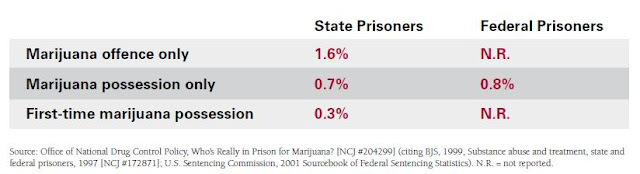

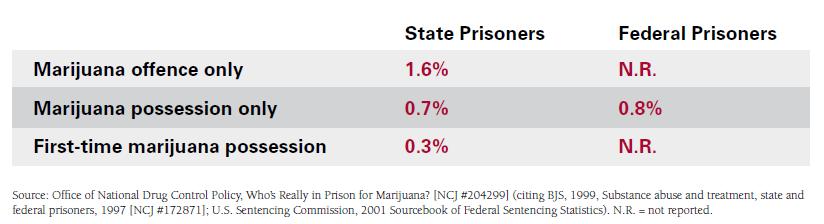
As the graphic below from True Compassion shows, many prisoners who are in jail for marijuana "pled down from more serious charges and . . . the true incarceration rate for simple marijuana possession is negligible."

More national experts weigh in against marijuana legalization
"Legalizing and normalizing marijuana will be a public health disaster," according to John Walter, Former Director of the White House Office of National Drug Control Policy.
"Marijuana use has been linked to mental illness and violence. Its use also interferes with the cognitive development in adolescents. Marijuana use has significant impacts on our school scores and drop-out rates, accidents and vehicle fatality rates, employment productivity, healthcare and treatment costs, and the potential escalation of further illicit drug use. In fact, more young people are in treatment for marijuana than any other drug," says Calvina Fay, Executive Director of the Drug Free America Foundation.
"Marijuana use has been linked to mental illness and violence. Its use also interferes with the cognitive development in adolescents. Marijuana use has significant impacts on our school scores and drop-out rates, accidents and vehicle fatality rates, employment productivity, healthcare and treatment costs, and the potential escalation of further illicit drug use. In fact, more young people are in treatment for marijuana than any other drug," says Calvina Fay, Executive Director of the Drug Free America Foundation.
Tuesday, October 16, 2012
Marijuana legalization "would reduce productivity of a significant segment of our workforce"
Yesterday, the Institute for a Drug-Free Workplace released a statement opposing the ballot initiatives in Washington, Colorado, and Oregon that would legalize marijuana. According to their press release:
- "Those who engage in illicit drug use are one-third less productive according to a Department of Health and Human Services report."
- "With the economy the #1 issue facing our country and the #1 issue in this election, enacting laws that would reduce productivity of a significant segment of our workforce by one-third would further undermine our economy and impede recovery."
- "Legalization would mean more use, and more use would mean a greater detrimental impact on the workplace, less productivity, and a less safe working environment for millions of American workers."
- . . . those who engage in illicit drug use are 3.6 times more likely to be involved in a workplace accident that injures themselves and/or another person or people."
Monday, October 15, 2012
Alcohol marketed to youth . . . is marijuana next?
What is the difference between these three products?


 The first picture (above left) shows two pouches containing alcopops.
The second product (above right) is a juice pouch.
The set of bottles (left) contain marijuana-infused beverages. Potpops?


 The first picture (above left) shows two pouches containing alcopops.
The second product (above right) is a juice pouch.
The set of bottles (left) contain marijuana-infused beverages. Potpops?
Friday, October 12, 2012
In 2006, 30 people arrested in Seattle for marijuana only
Below are two charts from the Final Report of the Marijuana Policy Review Panel on the Implementation of Initiative 75 which made the enforcement of marijuana laws the lowest priority for Seattle Police.
Table 1 shows that in 2006, there were 125 "total marijuana cases filed" by the Seattle Police Department. Of those, 30 (24%) were "marijuana only" charges.
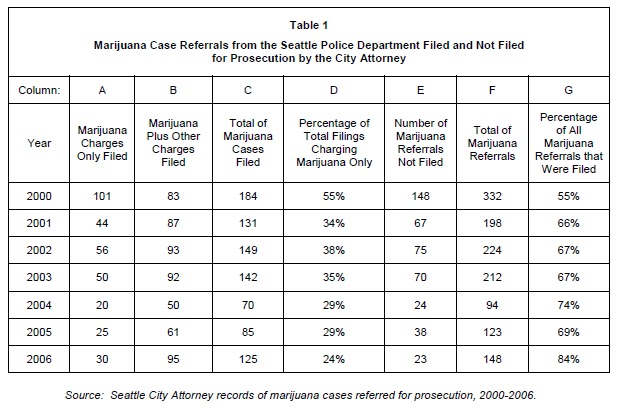
Table 7 shows that 0.8% of all misdemeanor filings in Seattle were for marijuana in 2006.

Here is another link to the report.
Watch the KYVE discussion about marijuana legalization
Check out David Rolfe from Safe Yakima Valley discussing marijuana legalization on KYVE: http://kcts9.org/insiders-roundtable/i-502-marijuana-law-reform.
Tuesday, October 9, 2012
Easy access to marijuana and alcohol
Okay, I am getting tired of the media spin about teen access to marijuana. Here is what the Washington State Healthy Youth Survey tells us.
In 2010, when Washington 10th grade students were asked how easy it would be to get alcohol and how easy would it be to get marijuana,
Now let's look at use rates:
In other words, though Washington 10th graders say alcohol and marijuana are easy to get, they use legal and regulated alcohol at higher rates. And that's what really matters -- how much kids are actually using. The data is easily available at www.AskHYS.net.
I kept writing "Washington high school students" above because national data tells a different story. Nationwide, teenagers find it easier to get legal and regulated alcohol and tobacco than illegal marijuana.
Another nationwide study shows that even when teenagers know of a peer who sells marijuana, they still use legal and regulated drugs at higher rates.
In 2010, when Washington 10th grade students were asked how easy it would be to get alcohol and how easy would it be to get marijuana,
- 56% said it would be easy to get alcohol
- 54% said it would be easy to get marijuana.
Now let's look at use rates:
- 28% report using alcohol within the last 30 days
- 20% report using marijuana within the last 30 days.
In other words, though Washington 10th graders say alcohol and marijuana are easy to get, they use legal and regulated alcohol at higher rates. And that's what really matters -- how much kids are actually using. The data is easily available at www.AskHYS.net.
I kept writing "Washington high school students" above because national data tells a different story. Nationwide, teenagers find it easier to get legal and regulated alcohol and tobacco than illegal marijuana.
Another nationwide study shows that even when teenagers know of a peer who sells marijuana, they still use legal and regulated drugs at higher rates.
Wednesday, October 3, 2012
Child psychiatrist's top ten reasons not to legalize marijuana
When it comes to marijuana policy, Colorado and Washington seem to be fairly similar. Both states have legal medical marijuana industries and both states will vote on full marijuana legalization next month. Therefore, I think a video of Dr. Christian Thurstone, from the University of Colorado at Denver, providing his "Top Ten Reasons Not to Legalize Marijuana" to the Colorado Child and Adolescent Psychiatry Society is pertinent to Washingtonians, as well.
Unfortunately, the video ends just as Dr. Thurstone starts talking about marketing marijuana to youth.
According to the Colorado Child and Adolescent Psychiatry website:
Recently, Colorado has seen staggering increases in adolescent marijuana use. Many parents, teens and teachers are confused about marijuana as both medicine and drug of abuse. Here is a link to materials written by our president, Dr. Thurstone, and the Colorado Department of Education called Understand the Big Deal: How Marijuana Harms Youth. This resource includes a one-page info sheet, a brochure and a slide set. Feel free to make copies and distribute.
Unfortunately, the video ends just as Dr. Thurstone starts talking about marketing marijuana to youth.
According to the Colorado Child and Adolescent Psychiatry website:
Recently, Colorado has seen staggering increases in adolescent marijuana use. Many parents, teens and teachers are confused about marijuana as both medicine and drug of abuse. Here is a link to materials written by our president, Dr. Thurstone, and the Colorado Department of Education called Understand the Big Deal: How Marijuana Harms Youth. This resource includes a one-page info sheet, a brochure and a slide set. Feel free to make copies and distribute.
Tuesday, October 2, 2012
Recent I-502 debates
With a month to go before the elections, debates about I-502 are heating up. Check out two of the latest ones to appear in Seattle media:
Seattle Times Live chat about legalizing marijuana in Washington
KCTS-9 Initiative 502 Debate.
Yesterday, an op-ed appeared in the Seattle Times: Don't legalize marijuana. It's addictive.
Seattle Times Live chat about legalizing marijuana in Washington
KCTS-9 Initiative 502 Debate.
Yesterday, an op-ed appeared in the Seattle Times: Don't legalize marijuana. It's addictive.
Friday, September 28, 2012
Racial disparities in advertising
As I have blogged about before, if approved Initiative 502 would create a marijuana industry similar to the alcohol and tobacco industries. I-502 contains restrictions on marijuana advertising that are similar to alcohol advertising restrictions -- it does not ban advertising in mass media (television, radio, newspapers, magazine, the Internet) and it does not ban marketing to youth.
While there are multiple studies that prove that alcohol and tobacco companies market to youth, a recent report highlights how alcohol ads target African American youth. According to the report, African-American youth ages 12-20 see more advertisements for alcohol in magazines and on TV compared with all youth ages 12-20.
Alcohol is the most widely used drug among African-American youth. At least 14 studies have found that the more young people are exposed to alcohol advertising and marketing, the more likely they are to drink, or if they are already drinking, to drink more.
“The report’s central finding—that African-American youth are being over-exposed to alcohol advertising—is a result of two key phenomena,” said author David Jernigan, PhD, the director of the Center on Alcohol Marketing & Youth. “First, brands are specifically targeting African-American audiences and, secondly, African-American media habits make them more vulnerable to alcohol advertising in general because of higher levels of media consumption. As a result, there should be a commitment from alcohol marketers to cut exposure to this high-risk population.”
A marijuana industry would act no differently than the alcohol and tobacco industries. If marijuana is legalized, it will only be a matter of time before African American and all youth are exposed to advertising messages created just for them.
While there are multiple studies that prove that alcohol and tobacco companies market to youth, a recent report highlights how alcohol ads target African American youth. According to the report, African-American youth ages 12-20 see more advertisements for alcohol in magazines and on TV compared with all youth ages 12-20.
Alcohol is the most widely used drug among African-American youth. At least 14 studies have found that the more young people are exposed to alcohol advertising and marketing, the more likely they are to drink, or if they are already drinking, to drink more.
“The report’s central finding—that African-American youth are being over-exposed to alcohol advertising—is a result of two key phenomena,” said author David Jernigan, PhD, the director of the Center on Alcohol Marketing & Youth. “First, brands are specifically targeting African-American audiences and, secondly, African-American media habits make them more vulnerable to alcohol advertising in general because of higher levels of media consumption. As a result, there should be a commitment from alcohol marketers to cut exposure to this high-risk population.”
A marijuana industry would act no differently than the alcohol and tobacco industries. If marijuana is legalized, it will only be a matter of time before African American and all youth are exposed to advertising messages created just for them.
Thursday, September 27, 2012
Teens don't use marijuana because . . .
Check out this new movie theater slide developed by Safe Yakima Valley and ESD 105!


Monday, September 24, 2012
Drug policy myth-busting
"Although some drug reform advocates talk about prisons overflowing with otherwise innocent first-time drug users, that is a myth; over 90 percent of those in prison for drug-law violations admit involvement in drug distribution, albeit often in very minor roles," according to the non-partisan RAND Drug Policy Research Center in their recently released paper: The U.S. Drug Policy Landscape - Insights and Opportunities for Improving the View.
While the paper highlights problems associated with supply reduction activities, the authors highlight one positive outcome: ". . . supply control is not futile" because enforcing drug laws imposes costs on the drug supply network, and "those costs are presumably passed along to consumers in the form of higher prices. Contrary to a once-prevalent myth, higher prices really do reduce drug use and initiation, and they also encourage cessation."
While the paper highlights problems associated with supply reduction activities, the authors highlight one positive outcome: ". . . supply control is not futile" because enforcing drug laws imposes costs on the drug supply network, and "those costs are presumably passed along to consumers in the form of higher prices. Contrary to a once-prevalent myth, higher prices really do reduce drug use and initiation, and they also encourage cessation."
Friday, September 21, 2012
Legal, regulated drugs continue to be trafficked
Legalizing marijuana will not rid our state of drug trafficking and related criminal organizations. Just check out what's going on in Virginia with legal and regulated cigarettes:
What kind of illegal smuggling has the highest profit margin for criminals? Moving heroin? Cocaine? Guns?
No. It's cigarettes.
Cigarette trafficking has become so lucrative that it is attracting organized crime and former drug smugglers . . .
. . . the profit margin on illegally trafficked cigarettes is now higher than on cocaine, heroin, marijuana or guns.
. . . cigarette smuggling has existed for years. But as the discrepancy among states' tax rates has widened in recent years, the problem has worsened.
"We see data in the field that just in the last year it is blooming in the commonwealth . . . because Virginia has the second-lowest cigarette tax in the nation, at 30 cents a pack (2010 figures give Missouri's tax as the lowest, at 17 cents). Every state to the north has a higher tax, and by the time you reach New York state, the tax is $4.35 a pack."
What kind of illegal smuggling has the highest profit margin for criminals? Moving heroin? Cocaine? Guns?
No. It's cigarettes.
Cigarette trafficking has become so lucrative that it is attracting organized crime and former drug smugglers . . .
. . . the profit margin on illegally trafficked cigarettes is now higher than on cocaine, heroin, marijuana or guns.
. . . cigarette smuggling has existed for years. But as the discrepancy among states' tax rates has widened in recent years, the problem has worsened.
"We see data in the field that just in the last year it is blooming in the commonwealth . . . because Virginia has the second-lowest cigarette tax in the nation, at 30 cents a pack (2010 figures give Missouri's tax as the lowest, at 17 cents). Every state to the north has a higher tax, and by the time you reach New York state, the tax is $4.35 a pack."
Thursday, September 20, 2012
Marijuana snow cones?
A few days ago, I wrote about I-502 opening the door for the development of a marijuana-infused food industry in our state. Such businesses already exist for medical marijuana.
A reporter from KPLU recently attended the "Medical Cannabis Cup" in Seattle and wrote about the marijuana-infused food that was offered in the "outdoor medicating section". Cotton candy and snow cones were among the medications. Here is a photo published with KPLU's story:

A reporter from KPLU recently attended the "Medical Cannabis Cup" in Seattle and wrote about the marijuana-infused food that was offered in the "outdoor medicating section". Cotton candy and snow cones were among the medications. Here is a photo published with KPLU's story:

Credit Ashley Gross / KPLU
Snow cones were just one of the options for ingesting marijuana at the Medical Cannabis Cup
Wednesday, September 19, 2012
News Tribune: marijuana legalization bad for juveniles
Earlier this week, the News Tribune published an editorial about I-502: Juvenile marijuana use: the fatal flaw of Initiative 502. Here are a few excerpts:
. . . Legalization would likely produce a surge of dope smoking among teenagers who now avoid it simply because it is stigmatized as illegal.
Kids notice what adults consider acceptable, and not all of them are hell-bent on rebellion. Federal data suggest that most adolescents either avoid alcohol and drugs, or only experiment with them.
. . . Legalization would likely produce a surge of dope smoking among teenagers who now avoid it simply because it is stigmatized as illegal.
Kids notice what adults consider acceptable, and not all of them are hell-bent on rebellion. Federal data suggest that most adolescents either avoid alcohol and drugs, or only experiment with them.
. . . Some of that difference can be explained by perceptions of what is legal among their elders. Legality will inevitably make marijuana more attractive to youth. Mere advertising campaigns aren’t likely to counteract that effect – especially since marijuana marketers will be doing their own advertising under I-502.
The initiative also wouldn’t shut down the black market or the drug cartels, as its supporters hope. For example, sales would still be forbidden to those under 21 – but does anyone believe that dealers will stop selling to them?
There may be ways to legalize or decriminalize marijuana for adults without creating a wider snare for juveniles. It would be nice if I-502 could do that. It’s likely to have just the opposite effect.
Subscribe to:
Posts (Atom)